Fed up with disruption, travelers lean on AI

Holiday travel is right around the corner, and while travelers may not have booked their flights yet, they have already planned for disruption.
Parloa surveyed 1,000 U.S. adults to get a sense of how they’re feeling about customer experience (CX) across travel providers, from airlines and hotels to booking platforms. The sentiment was clear: disruption (and frustration) is expected, travelers see the benefit in letting AI do the frustrating work for them, and all they really care about is complete resolution to their problems.
Finding #1: Travelers expect trouble before they leave home
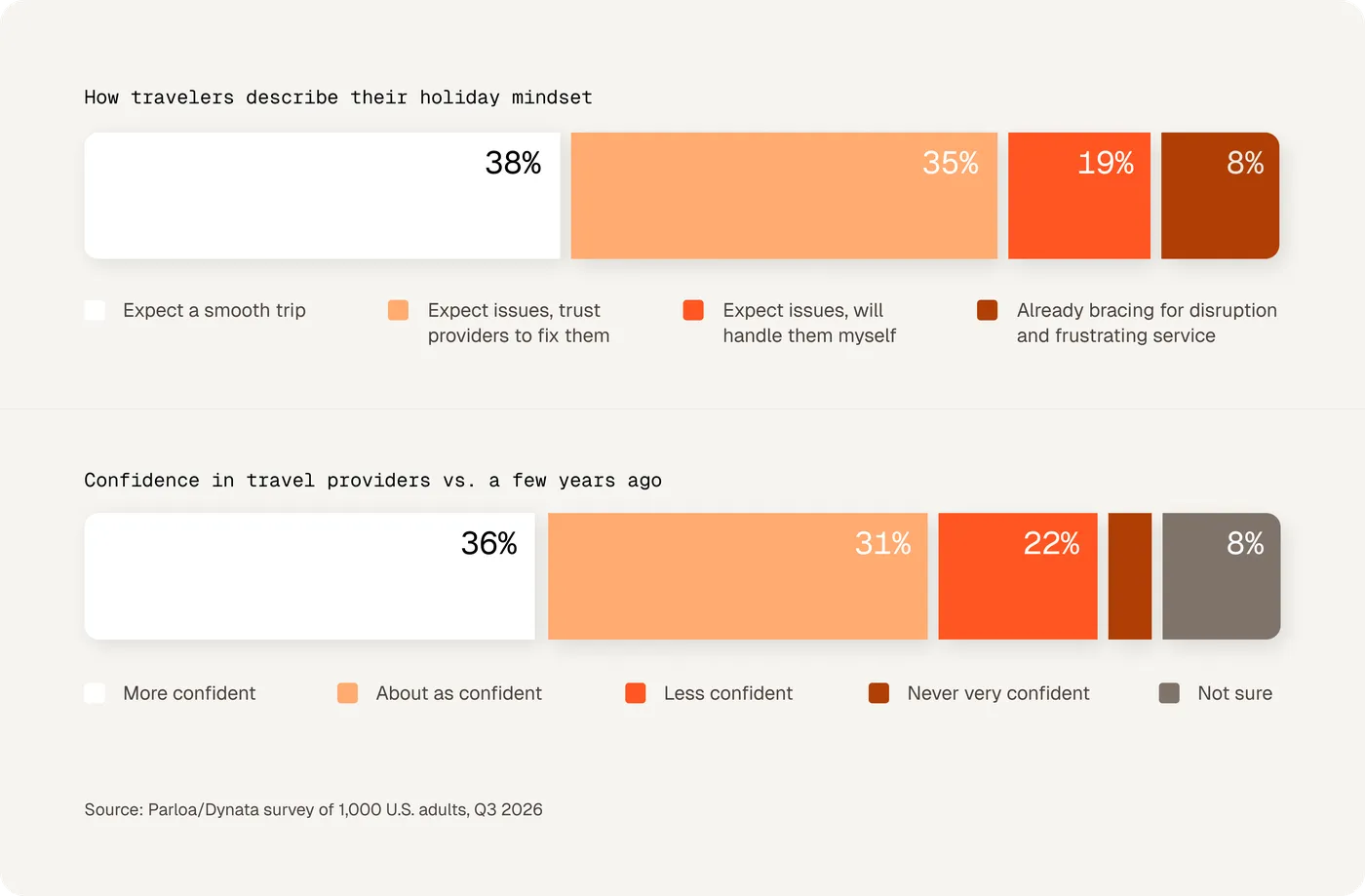
62% of respondents expect at least some disruption or customer service issues this holiday season, and only 27% of those respondents trust travel providers to resolve those issues.
This lack of trust falls in line with the general lack of confidence consumers hold for travel customer experience programs.
56% of respondents said that their confidence in airlines, hotels, and booking platforms to provide smooth, reliable experience is unchanged or lower than a few years ago.
Finding #2: AI for monitoring, humans for action
While the majority of consumers anticipate disruption to their travel, only 7% of respondents said they would use AI to take action during such disruption.
Instead, the 53% of respondents who said they would use AI for holiday travel are largely using it to monitor their plans, alert them of disruptions, compare providers, or help them come up with ideas of where to go. In other words, they use AI to keep eyes on the things they can’t monitor every day, and to do a little extra thinking for them. They have yet to put AI agents into action.
That doesn’t mean there’s no interest in doing so, however. Interest in using AI agents to take action on respondents’ behalf increased as age of the respondent decreased across the survey.
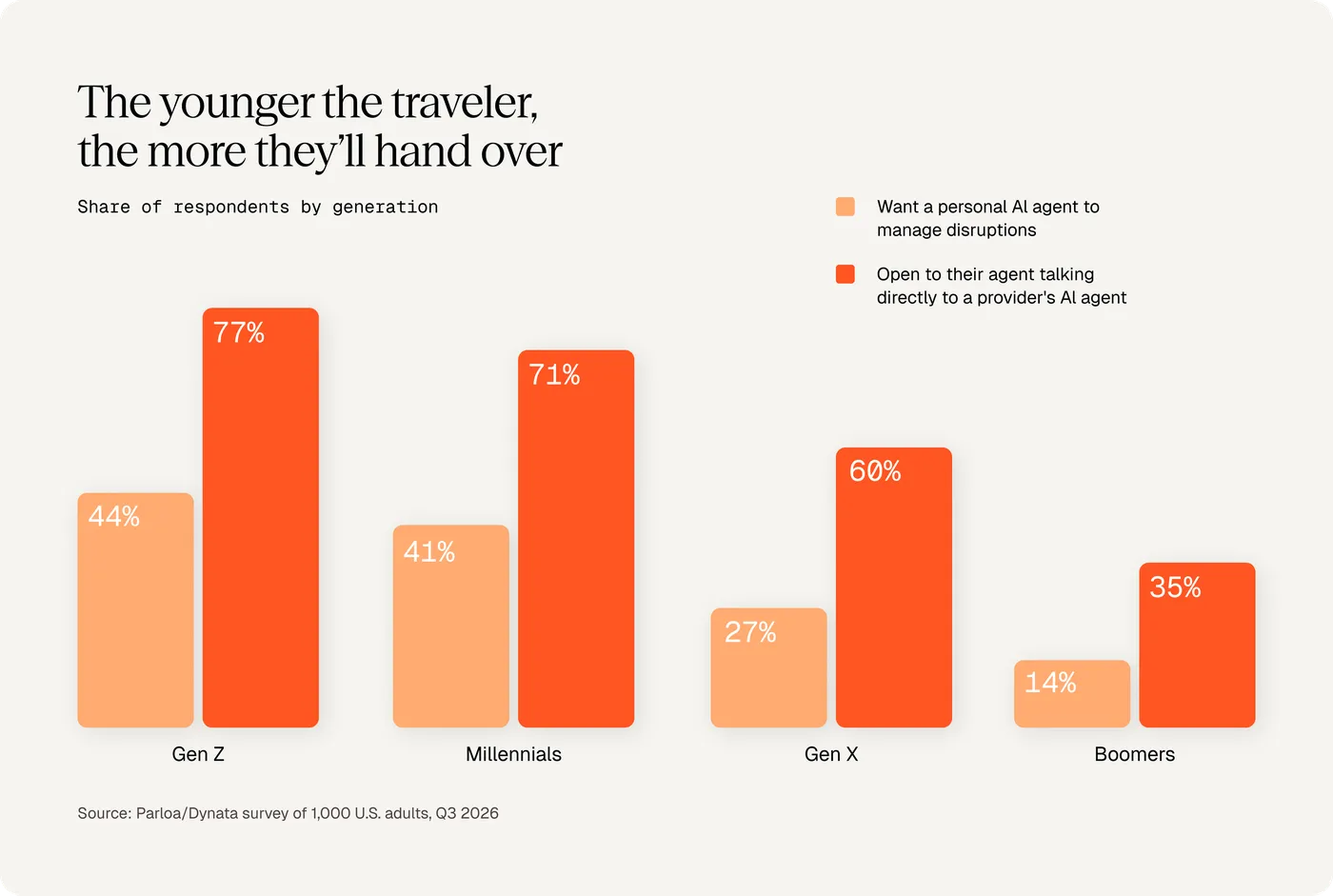
44% of Gen Z and 41% of Millennials said they’d be interested in using a personal AI agent to manage disruptions, while only 27% of Gen X and 14% of Boomers reported the same level of interest.
The same pattern shows up for agent-to-agent interaction. 77% of Gen Z, 71% of Millennials, 60% of Gen X, and 35% of Boomers say they'd be open to their AI agent communicating directly with a provider's AI agent. Another 19% would rather let the two agents work it out than deal with customer service themselves.
Despite Finding #2’s statistics, 32% of respondents also placed using personal AI agents to take over CX interactions when something went wrong as a top use case for the technology. 42% would let their agent work with an airline's or hotel's AI agent as long as they could still approve important decisions.
When it comes to frustrating experiences, respondents indicate they’re willing to give more over to AI.
Finding #3: Complete resolution builds trust in AI
Today, when a provider routes respondents to AI, 60% react positively or with an open mind. 15% see it as potentially faster and easier.
But at the end of the interaction, all that really matters to the consumer is: Did it resolve my issue?
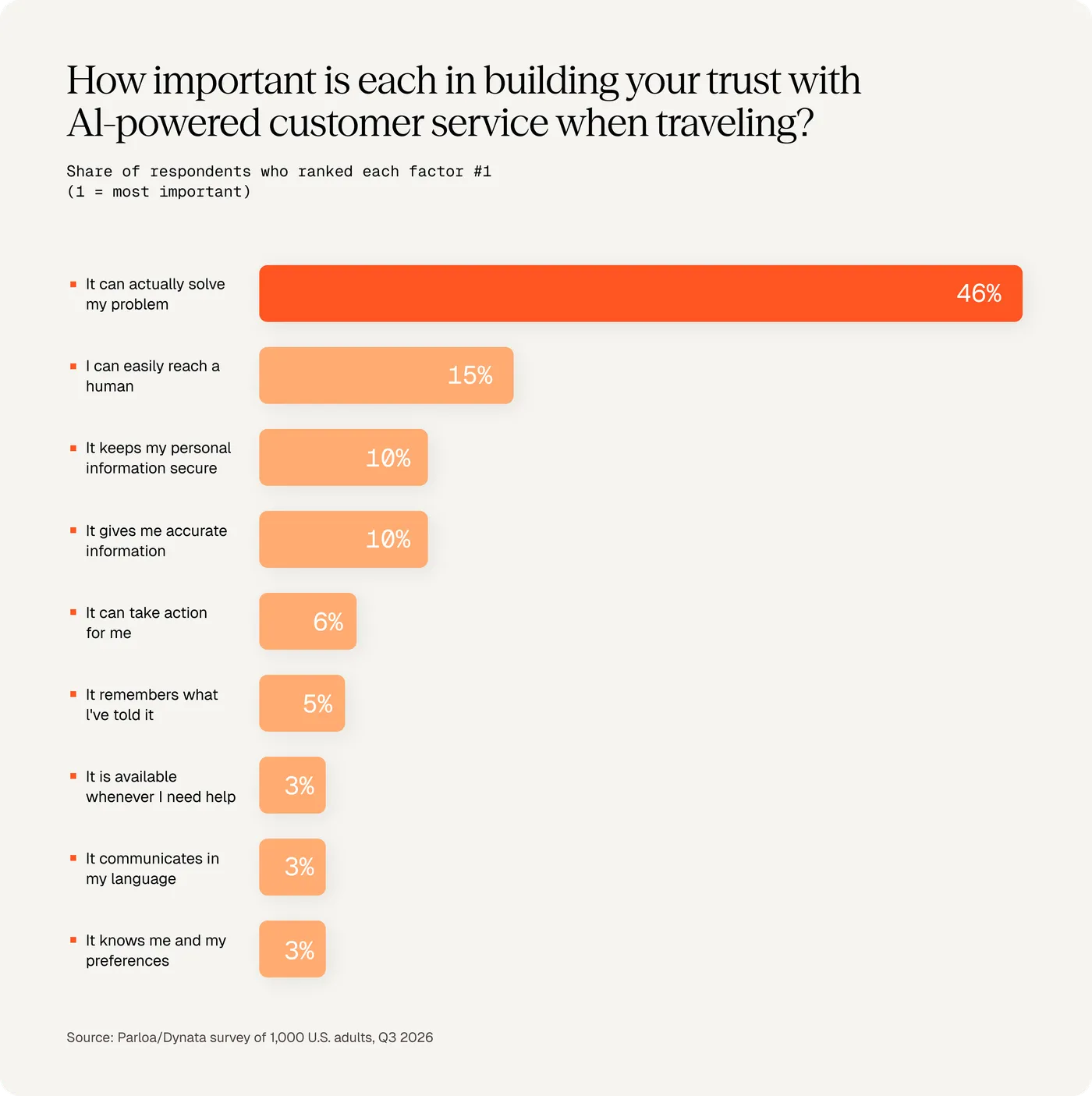
When asked about what they would think if a travel provider routed them to an AI agent for help, 21% of respondents said AI could work well if it fully resolves the issue. Another 24% don't care who they get help from, as long as they get it, and their problem is resolved. In fact, nearly half of all respondents ranked full resolution as the most important factor to trusting AI-powered CX in the travel industry.
How travel brands can build customer loyalty this holiday season
Travelers have already decided how this holiday season will go, but there’s still time to change the narrative. While booking platforms can’t control the weather, they can control what happens when someone needs to rebook because of it.
With 83% of US consumers (opens in a new tab) tying brand loyalty to their support experiences, the holiday season offers a unique opportunity to win customers for life through service that is proactive, fast, and provides full resolution to every traveler.
That’s the type of service agentic AI can deliver.
Ready to eliminate frustration for your travelers? Read Parloa’s Getting started with voice AI agents in travel & hospitality guide.
Methodology: Parloa surveyed 1,000 U.S. adults aged 18 and older in partnership with Dynata in Q3 2026.