Experience fast ROI with these three workflows for agentic AI in healthcare

Patients are at the center of every healthcare experience, and access is often where that experience begins. Yet, many health systems still rely on manual administrative workflows that weren’t designed for today’s call volume, staffing constraints, and patient expectations.
In service operations, first-call resolution (FCR) is a practical measure of whether people can accomplish their goal without repeat effort. Industry benchmarks place average FCR near 70%, (opens in a new tab) meaning for 30% of patients, they need additional follow-up, escalation to other teams, or repeated contact attempts to get their questions answered. That level of friction is especially costly in healthcare, where patients who can’t seamlessly engage with healthcare providers may end up deferring treatment, missing appointments, or stop following up. Most patients continue to cite poor communication, lack of personalized care, and long wait times (opens in a new tab) as the main cause of their dissatisfaction.
This pressure doesn’t only affect patients, but the workers trying to manage the requests, too. Healthcare workers experience high levels of burnout (opens in a new tab), often citing workload, time pressure, staffing challenges, and technological barrier (opens in a new tab)s as the core reasons.
That’s why Parloa has integrated with Epic, to empower healthcare workers to leverage agentic AI to handle the most repetitive, high-volume, non-clinical, administrative patient requests. As these processes typically follow clearly defined workflows and need system-level context, Parloa’s AI agents can securely connect with the Epic database to execute routine patient request interactions. With Parloa, healthcare providers can resolve more requests in the first interaction, reducing healthcare staff’s workload and offering employees more time and energy to focus on the important, complex, and critical moments where patients need a person the most.
Why Parloa for Epic?
Parloa builds agentic AI for customer service. In healthcare, that mission translates to AI agents delivering completed outcomes for patients and clear, well-documented handoffs for staff. Epic provides the system of record for patient context and workflow state. Parloa provides the system of action that executes the workflow, captures the result, and routes exceptions with full context.
With Parloa integrated into Epic, the most common patient calls can be automated: schedule a visit, change an appointment, confirm details, understand a bill, reset portal access, and route to the right team. By leveraging Epic as a source of truth, Parloa’s AI agents come to every patient conversation with complete context, so patients don’t need to repeat themselves but instead experience more personalized, real-time interactions. On the other side, healthcare workers are given bandwidth to focus on more strategic initiatives, reducing burnout and lowering turnover risk.
How does Parloa’s integration with Epic work?
Ensuring patients have access to the care they need, when they need it, is not an easy feat. That is true for all healthcare providers but especially for systems and groups that serve large, diverse populations with complex needs. EHR systems provide a unique opportunity for organizations to bring operational rigor to the workflows that once ran on pen and paper.
Patient access workflows, while different for every provider, can often be defined by a repeatable sequence of steps, checks, and success criteria. The successful support of patient access to care requires a thoughtful and considered understanding of what a patient needs combined with an in-depth understanding of clearly defined policies that can be consistently applied. It also requires responsible and strictly HIPAA-compliant access to patient data that is both accurate and comprehensible.
Parloa’s AI agents form a loop with Epic, where the agent can source live information for scheduling and billing, and work with the patient through natural conversation while taking action in the relevant Epic modules.
Getting started and scaling Parloa’s integration with Epic follows six key steps:
Select a high-volume, clearly defined, non-clinical workflow such as appointment scheduling, reminders, or billing inquiries.
Define the policies, allowable actions, and guardrails. Establish what you want the agent to be able to do when it comes to authentication (e.g. collect a certain amount of PII points, don’t reveal certain patient information, and disclosure readouts). Define which actions will require confirmation from patients and when a conversation should be handed off to patient access staff.
Define how patient requests are authorized and identity is confirmed. Work with security and compliance stakeholders to align on scope and workflow-specific policies.
Pressure test the agent with simulated and real conversations to find the outliers and edge cases. Validate agent behavior across real-world scenarios using scripted and exploratory testing.
Launch and scale your agents progressively to your patients. Continuous monitoring of agent performance allows you to scale your agent with confidence.
Expand the workflow library. Add workflows in a predictable cadence with consistent governance.
Epic-connected AI agent deployments succeed through phased rollout and explicit operational ownership. By following the six steps mentioned above, healthcare systems will work towards an AI agent program that grows in capability and trust within a highly sensitive environment.
Three agentic workflows for quick patient value
Parloa’s AI agents excel in automating repetitive workflows, which is most often where humans tire. To quickly realize the positive impact of agentic AI on both patients and workers, we recommend using the Parloa integration with Epic to automate these three workflows:
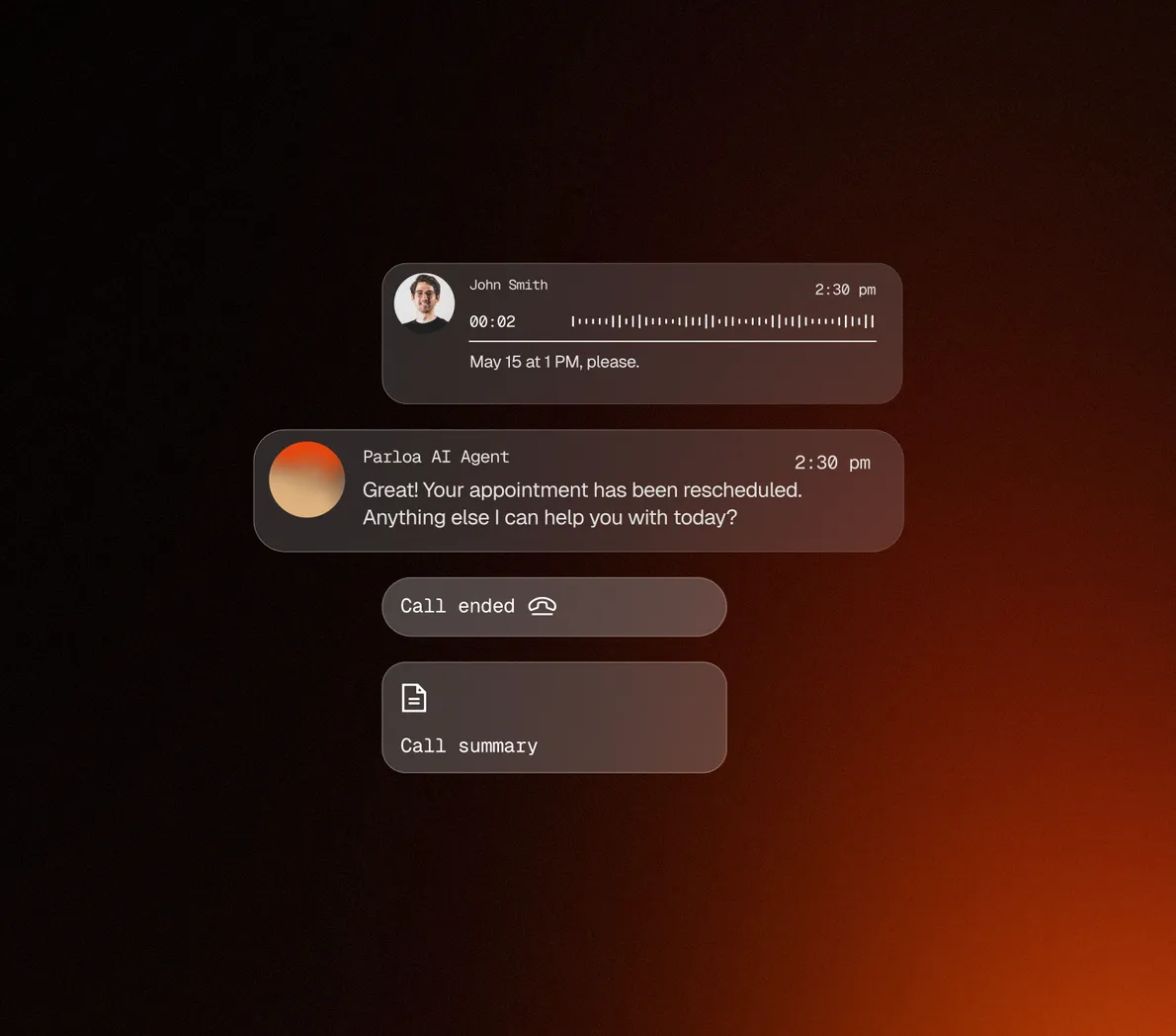
Workflow #1: Appointment scheduling
Goal: Move from patient intent to a new appointment booked through Epic. Provide confirmation to the patient and document the changes in Epic.
Three metrics to measure success:
Appointments booked
Escalation quality
Staff scheduling workload (should reduce)
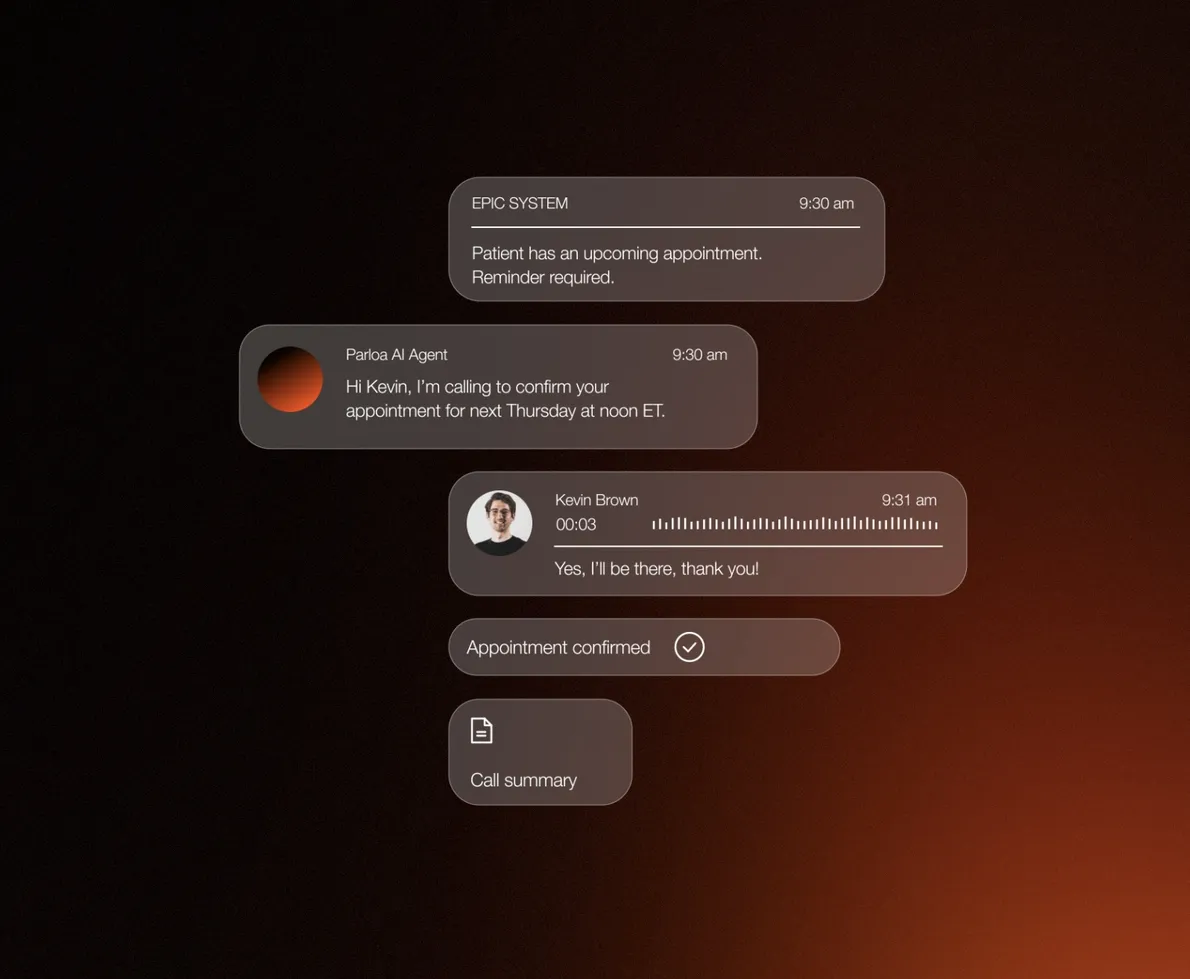
Workflow 2: Appointment reminders and confirmations
Goal: Confirm appointment attendance and manage changes through outreach and inbound follow-up.
Three metrics to measure success:
Amount of confirmed/recovered appointments (should increase)
Improved schedule utilization
Reminder-related inbound calls (should reduce)
Workflow 3: Billing inquiries
Goal: Resolve common billing inquiries through clear explanations and guided next steps.
Three metrics to measure success:
First-contact resolution rate (improves)
Billing call backlog (lessens)
Repeat contacts (lessens)
Start delivering better experiences for your patients and your employees
Parloa’s integration with Epic alleviates the major pain points hindering positive patient and employee experiences today. With voice AI agents, no patient ever needs to be put on hold, or wait to call back another day. With context central to every conversation, Parloa’s AI agents deliver more personalized experiences that ensure streamlined, closed-loop experiences.
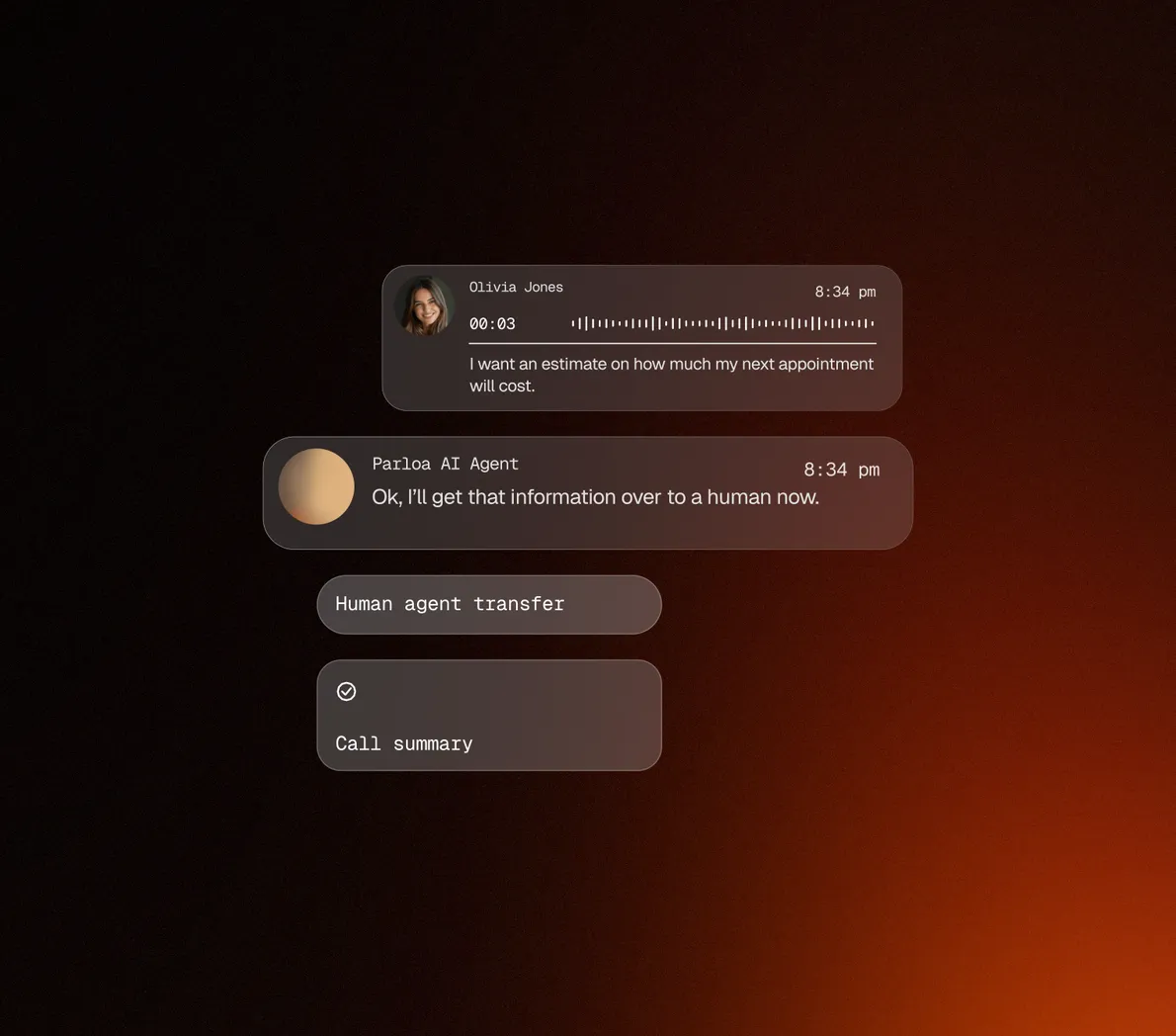
Finally, by passing all information back to Epic, healthcare workers never lose track of conversations, ensuring auditability and traceability every time.
Are you ready to start mitigating burnout and increasing patient satisfaction? Contact Parloa to schedule a patient access workflow assessment.
Epic is a registered trademark of Epic Systems Corporation.